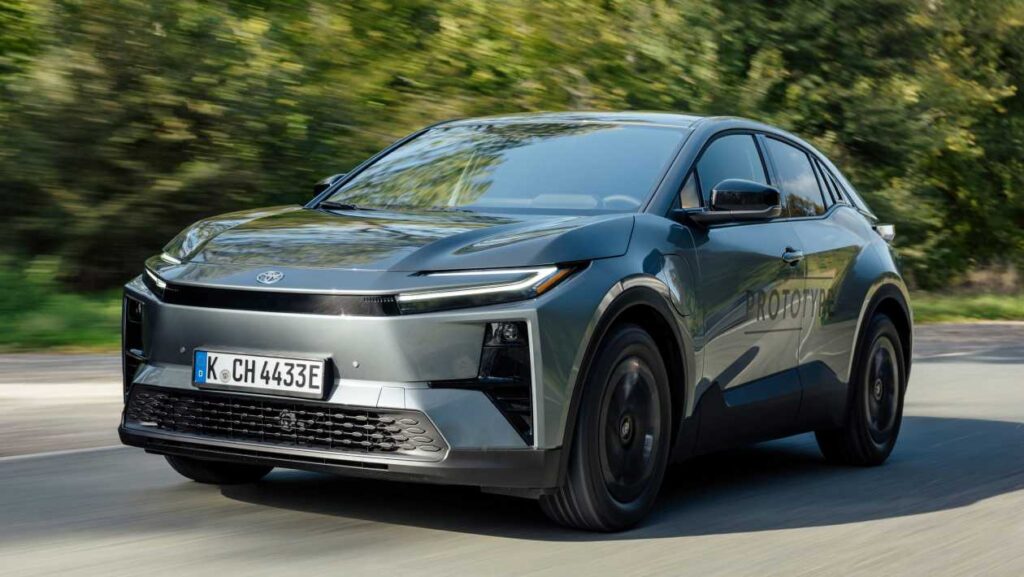
But the surge of power delivery is good, when you haven’t upset the traction control, and the C-HR+ has four levels of brake energy regeneration to further aid the impressive efficiency, with the top setting not quite bringing the car to a halt for full one-pedal driving. They’re controlled via the paddles behind the steering wheel, which as well as feeling cheaper than the other main touch points in the cabin, are also confusingly set for the minus paddle increasing regen and the plus paddle decreasing it.
We saw around 3.7 miles per kWh on our briskly driven test route, so well over 4.0 is easily achievable in regular driving, meaning a real-world range of more than 300 miles.
Our drive, which weaved in and out of small villages outside Paris, did throw up the perennial new-car issue of interminable beeping. Every change of speed limit comes with multiple beeps, and it’s regularly joined by other irritating chirps. A dive into the menus turns them off, but other cars are both less intrusive and relentless, and easier to disable to save your sanity if you’re not a fan.
The 14-inch central touchscreen is, much to our delight, supplemented by rotary dials for the climate control, and buttons for front and rear demist. Take note Chinese brands in particular, where everything runs through the touchscreen. The bad news on the overall visibility score is that there’s no rear wiper, another frustrating modern trend. Doubly so when rear visibility through the narrow sloping screen and around the chunky rear pillars isn’t great.
Cabin quality is good, although we’ll reserve final judgement to when we see the production models. As you’ll have spotted from the decals, we were given access to very late-stage development cars, complete apart from some interior finishes. And not slathering the word Prototype across the side. But the quality and variety of materials is good, especially at the upper levels of the cabin, although the small door pockets are cheaper hard plastic. The best of the stowage is the deep central area under the armrest and a tray with a USB-C port beneath the so-called digital island that houses the gear selector and a pair of wireless charging pads. Oddly, there’s no glovebox at all.
Paul Barker
Source link